Agentic Commerce and Customizable Products: What Shopify Merchants Need to Know About Google’s UCP
Google’s Universal Commerce Protocol (UCP) promises to let AI agents handle everything from product discovery to checkout. Sounds revolutionary.
 Martin Frank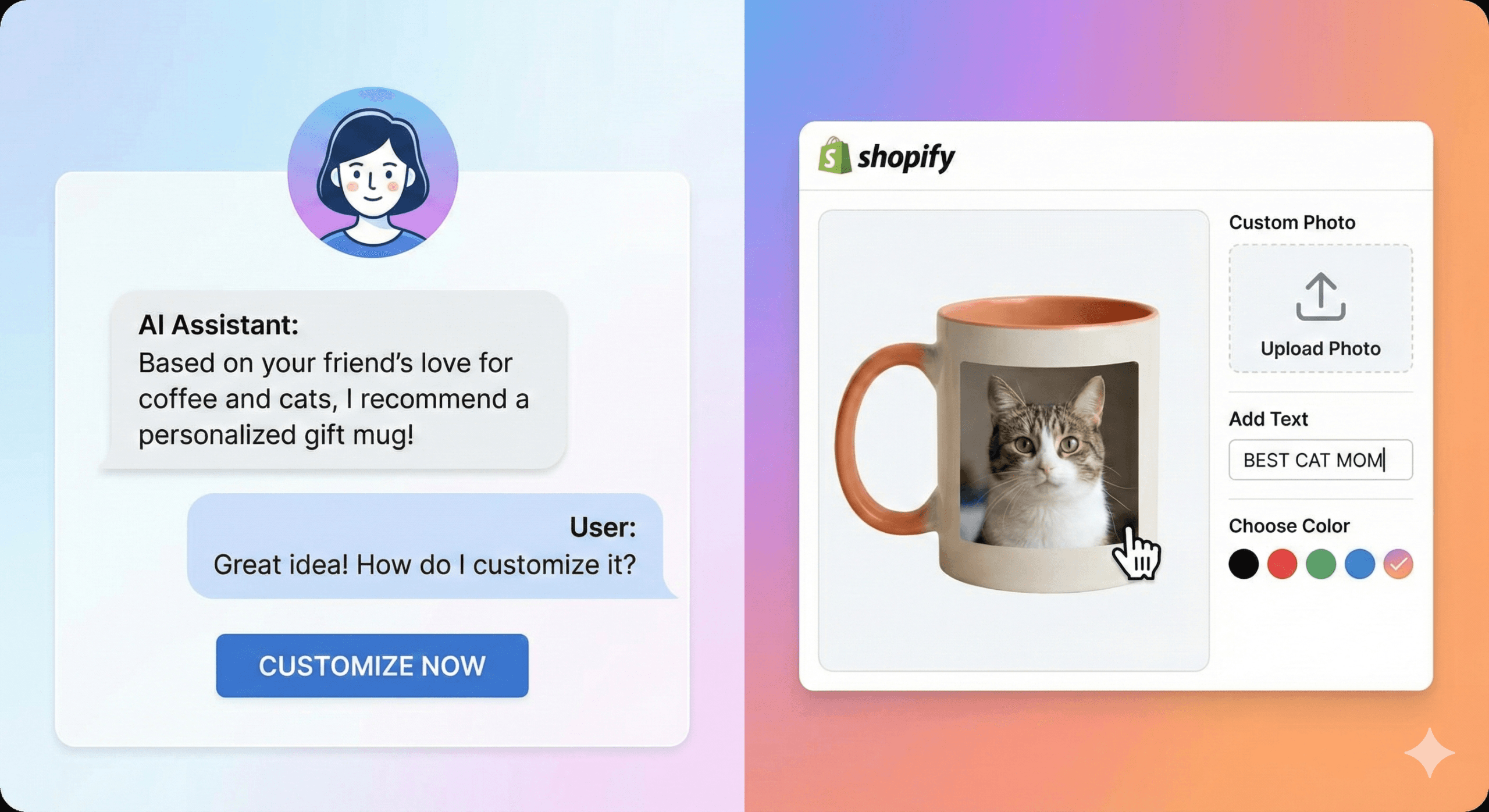
That’s not a dealbreaker. It’s actually an opportunity, if you know how to position your store for the hybrid commerce model that’s emerging. This guide breaks down what agentic commerce means for customizable product merchants, why the limitations create strategic advantages, and exactly how to prepare your Shopify store for AI-driven shopping.
What is the Universal Commerce Protocol?
The Universal Commerce Protocol is an open standard announced by Google at the National Retail Federation conference in January 2026. Co-developed with Shopify, it creates a shared language that allows AI shopping agents to complete entire purchase journeys on behalf of consumers.
Think of it as a translator between AI assistants and online stores. When someone asks Google’s AI Mode, “Find me a gift for my sister who loves gardening,” the AI can now search across thousands of merchants, retrieve detailed product information, show options, and process checkout, all within the conversation.
The protocol supports three core functions:
- Discovery: AI agents search products across merchants, pulling specifications, pricing, and availability
- Checkout: Creating payment sessions, collecting buyer information, processing transactions via Google Pay
- Post-purchase: Order tracking, returns processing, customer support handoffs
Major partners include Shopify, Etsy, Wayfair, Target, and Walmart, with payment processing support from Stripe, Adyen, Visa, Mastercard, and American Express. Shopify merchants can already sell directly through Google AI Mode, the Gemini app, ChatGPT, Microsoft Copilot, and Perplexity.
For standard products with fixed specifications, UCP enables genuinely seamless transactions. The AI handles everything.
But customizable products operate differently.

How agentic commerce works for standard products
Before diving into the customization challenge, it helps to understand the ideal flow Google envisions for standard products.
A customer tells their AI assistant: “I need running shoes, size 10, good for trail running, under $150.” The agent searches across merchants, compares options based on reviews and specifications, presents recommendations, and when the customer says “Buy the Salomon ones,” processes checkout using stored payment credentials. Order confirmation arrives. Tracking updates flow through automatically.
The customer never visits a website. Never browses product pages. Never enters shipping details manually.
This is why retailers are racing to integrate. According to Shopify data, agent-sourced orders have increased 14 times over the past twelve months. Adobe reported a 670% year-over-year increase in AI-driven traffic to retail sites during Cyber Monday 2025. Morgan Stanley projects roughly half of online shoppers will use AI shopping agents by 2030.
The stakes are enormous. McKinsey estimates agentic AI could represent a three to five trillion dollar retail opportunity by 2030. Merchants who aren’t discoverable by AI agents risk becoming invisible to a growing segment of shoppers.
But here’s where customizable product merchants face a fundamentally different reality.

The challenge for customizable products
Buried in Google Merchant Center’s documentation is a critical limitation:
“Personalized goods (items requiring custom design decisions such as engravings, monograms) are ineligible for native checkout features.”
This isn’t arbitrary. The limitation reflects a genuine technical and experiential problem that AI agents can’t yet solve.
The configuration complexity problem
Custom products require input that AI agents struggle to facilitate. When a customer wants to personalize a coffee mug, they need to:
- Choose a design layout
- Upload their own image or select from graphics
- Add custom text with specific fonts and colors
- Preview how everything looks on the actual product
- Approve the final design before purchasing
AI agents can handle preferences (“I want a funny mug for my dad who golfs”). They can’t facilitate the iterative design process where customers adjust text placement, try different fonts, and decide whether their uploaded photo looks good at that size.
Traditional product configurators and custom product builders handle this complexity through visual interfaces. AI agents can understand that complexity exists, but they can’t replicate the interactive experience these tools provide.
The preview problem
Customers purchasing personalized products need to see exactly what they’re getting before they commit. A t-shirt with custom text requires visual confirmation that the design placement looks right. A phone case with an uploaded photo needs preview showing how the image will appear. An engraved cutting board needs mockup verification before production begins.
This visual approval loop doesn’t fit the conversational commerce model where AI agents present options and customers select.
The pricing problem
Customizable products often have dynamic pricing based on configuration choices. Adding a second print location increases price. Selecting premium materials adds cost. Complex designs with multiple colors may have different pricing tiers.
AI agents work best with fixed prices they can communicate clearly. Variable pricing based on customer decisions during configuration creates friction in the agentic model.
The production problem
Made-to-order and print-on-demand products require print-ready file generation after configuration. The customer’s design choices need translation into production files. This backend complexity happens after checkout, but the entire workflow depends on capturing accurate configuration data during the purchase process.

The agentic commerce opportunity for customizable products
Here’s where conventional thinking about UCP misses the bigger picture.
Most coverage frames native checkout eligibility as the goal. If your products can’t complete checkout within AI conversations, you’re somehow losing. But this perspective ignores how the Universal Commerce Protocol handles custom products through its graceful handoff architecture.
Discovery still works
AI agents can absolutely discover, recommend, and communicate about customizable products. When someone asks their AI assistant for “personalized gift ideas for a wedding,” your custom cutting boards, engraved wine glasses, and monogrammed towels can appear in recommendations.
The limitation is checkout completion within the AI conversation. Discovery, comparison, and recommendation all function normally. Your products can still surface when relevant queries happen.
Graceful handoff by design
UCP includes protocol-level support for routing transactions to merchant checkout when agents can’t complete them autonomously. This isn’t a failure mode. It’s intentional architecture recognizing that some purchases require merchant-controlled experiences.
When an AI agent recommends your customizable product and the customer wants to proceed, the handoff to your store is designed to feel seamless. The customer lands in your visual product customizer with context about what they were searching for.
Embedded checkout protocol
Merchants can maintain branded, customized checkout experiences within the UCP framework. You’re not forced into Google’s generic checkout flow. Your store’s personality, your design tools, your approval workflows all remain intact.
Custom extensions
UCP allows merchants to define bespoke functionality that agents can communicate about. You can structure information about your customization options, turnaround times, and design capabilities in ways AI agents can relay to potential customers.
The hybrid advantage
Think about what customizable products actually offer: differentiation, premium pricing, emotional connection, higher conversion once customers engage with design tools.
The AI shopping agent era doesn’t eliminate these advantages. It potentially amplifies them.
Standard products face brutal price competition when AI agents compare identical items across dozens of merchants. Customizable products offer something agents can recommend but competitors can’t replicate. Your customer’s personalized design is unique to your store.
Merchants who build excellent customization experiences benefit from AI driving discovery while maintaining the high-touch configuration process that commands premium prices and builds customer loyalty.

How to prepare your customizable product store for Shopify agentic commerce
Whether you’re focused on Shopify agentic commerce integration or understanding how Google UCP handles product customization, the preparation framework remains the same. AI shopping agents excel at personalization during discovery but need merchant-controlled experiences for configuration.
Preparation requires attention to two distinct moments: AI discovery and post-handoff conversion.
Optimize your product data for AI discovery
AI agents can only recommend products they can find and understand. Your Merchant Center feeds and product data determine visibility.
Include “custom” and “personalized” strategically
When shoppers ask AI agents for personalized gifts or custom products, keyword matching still matters. Include variations like “custom,” “personalized,” “made to order,” and “customizable” in your product titles and descriptions where natural.
Instead of “Ceramic Coffee Mug 11oz,” use “Custom Ceramic Coffee Mug 11oz – Add Your Photo or Text.”
Submit representative variants
For products with endless personalization possibilities, submit variants showing the range of what’s possible. A sample design demonstrating text customization, an example showing photo personalization, a variant featuring your pre-made designs.
These examples help AI agents understand and communicate what customers can create.
Use proper identifier settings
Custom products should use identifier_exists = FALSE in your product feed since each item is unique. This tells Google the product doesn’t have a standard GTIN or MPN, which is expected for personalized goods.
Structure your product descriptions for AI comprehension
AI agents parse your product descriptions to answer customer questions. Structure information clearly:
- What can be customized (text, images, colors, materials)
- Turnaround time for made-to-order items
- Any limitations (character counts, image requirements)
- What’s included (proofing, revisions, packaging)
Set up your Shopify knowledge base
Shopify’s agentic commerce tools allow merchants to define information that AI agents can access when answering customer questions.
Document your customization process
Create content explaining how your personalization works:
- Step-by-step design process
- How to upload images
- Font and color options available
- Preview and approval workflow
- Timeline from order to delivery
This information trains AI agents to set accurate expectations before handoff.
Build FAQ content
Address common questions AI might encounter:
- “Can I see a proof before production?”
- “What file types do you accept for image uploads?”
- “How long does a custom order take?”
- “Can I order multiples with different designs?”
Define what agents can promise
Be specific about guarantees and policies:
- Satisfaction policies for personalized items
- Rush order availability
- Shipping timelines for made-to-order products
Ensure your customizer delivers on the handoff
When AI agents send customers to your store, those visitors arrive with intent but high expectations. They’ve been told your products are customizable. Now they need to experience it.
Mobile optimization is essential
Many AI interactions happen on phones. The handoff from Gemini or ChatGPT drops customers directly into your mobile experience. If your product customizer loads slowly or frustrates on small screens, you’ll lose conversions from AI-referred traffic.
According to Chamevo’s merchant data, 70-80% of e-commerce traffic comes from mobile devices. AI commerce will likely skew even more mobile.
Speed matters more than ever
AI users expect instant. They’ve been having a natural conversation, got a recommendation, and clicked through. A slow-loading customization experience creates jarring friction.
Optimize your product pages for speed. Ensure your design tools load quickly. Remove unnecessary elements that slow the path to customization.
Clear path from discovery to design
AI-referred visitors may land on product pages without context about your store. Make it immediately obvious:
- What they can customize
- How to start designing
- What the process involves
Don’t assume familiarity with your brand or products.

Automate your backend for scale
Agentic commerce promises to increase order volume for merchants who optimize for it. Your backend needs to handle growth without proportional increases in manual work.
Print-ready exports matter more
When AI drives more discovery and your customizer handles conversion, production becomes the constraint. Automated print-ready exports that generate production files without manual intervention let you scale order processing.
Manual file fixing that takes ten minutes per order becomes unsustainable when order volume doubles or triples.
Integrate your production workflow
Connect your customizer to your fulfillment systems. Whether that’s Printful integration, direct printer connections, or cloud storage delivery to your production team, automation reduces the friction between customer order and production start.
Prepare for order surges
AI recommendation patterns can be spiky. A mention in the right AI conversation could drive significant traffic quickly. Ensure your systems can handle volume increases without breaking.
What this means for different product categories
Agentic commerce impacts different customizable product types in distinct ways.
Custom apparel and t-shirts
High discovery potential exists for gift queries, event merchandise, and personal expression. The design handoff works well since customers expect to interact with design tools when creating custom shirts. Focus on mobile optimization and fast loading for your apparel customization experience.
Personalized drinkware and gifts
A 3D product customizer becomes a key differentiator for this category. When AI sends gift shoppers to your store, showing their design wrapped around a mug or tumbler in realistic 3D builds confidence standard product photos can’t match. The interactive 3D product preview lets customers spin, zoom, and verify their personalization before purchasing.
Custom signs and wall art
Complex customization requiring text layout, size selection, and color choices benefits from guided experiences. AI can handle discovery (“I need a custom neon sign for my business”), but the configuration process requires your design tools. Focus on making the transition from AI conversation to design experience feel natural.
Phone cases and accessories
Mobile-first optimization is critical since customers shopping for phone accessories are almost certainly on their phones. The path from AI recommendation to phone case customization needs to be seamless on mobile devices.

The hybrid future of agentic commerce and customizable products
The agentic commerce era doesn’t eliminate the need for product customization experiences. It creates a new division of labor that benefits merchants who understand the opportunity.
AI agents excel at understanding intent, searching options, making recommendations, and processing standard transactions. They struggle with iterative design processes, visual approvals, and complex configurations.
Customizable product merchants benefit from this division. AI handles the discovery and qualification that previously required advertising and marketing investment. Your product configurator handles the conversion moment that turns intent into orders.
The handoff from AI conversation to custom product builder becomes the new conversion point. Merchants who build excellent experiences at that transition capture the value AI-driven discovery creates.
Don’t wait for AI to “solve” customization. The technology won’t eliminate the need for design tools and visual previews. Instead, invest in the experience that AI-referred customers will encounter when they arrive.
Prepare your product data for AI discovery. Optimize your mobile customization experience. Automate your production workflow to handle the volume growth agentic commerce enables.
The future of agentic commerce for customizable products isn’t a threat to personalization merchants. It’s an opportunity. The merchants who treat this transition as a strategic advantage will capture disproportionate value as AI shopping agents become mainstream.
Ready to build the customization experience AI shoppers expect? Try Chamevo’s product customizer on Shopify and see how automated print-ready exports and 3D visualization position your store for the agentic commerce era.