How to scale a custom apparel business past $10K/month
This guide breaks down why custom apparel businesses stall at this stage, the specific bottlenecks that cause it, and how to build systems–including automated print-ready exports and streamlined production workflows–that let you scale past $10K without hiring a team or burning out. If you want to scale custom apparel business operations beyond what manual processes allow, start here.
 Martin Frank
This guide breaks down why custom apparel businesses stall at this stage, the specific bottlenecks that cause it, and how to build systems–including automated print-ready exports and streamlined production workflows–that let you scale past $10K without hiring a team or burning out. If you want to scale custom apparel business operations beyond what manual processes allow, start here.
The math behind the $10K ceiling in custom apparel
Before diagnosing bottlenecks, understand what $10K per month looks like operationally.
The custom t-shirt printing market continues to grow, with the broader print-on-demand sector projected to reach $102.99 billion by 2034. Apparel holds nearly 40% of that market. Custom t-shirt business scaling is a challenge nearly every merchant faces as volume increases–demand is not the problem.
At a typical average order value of $35, $10K per month means roughly 286 orders–about 10 per day. At this volume, every manual step in your workflow consumes real time:
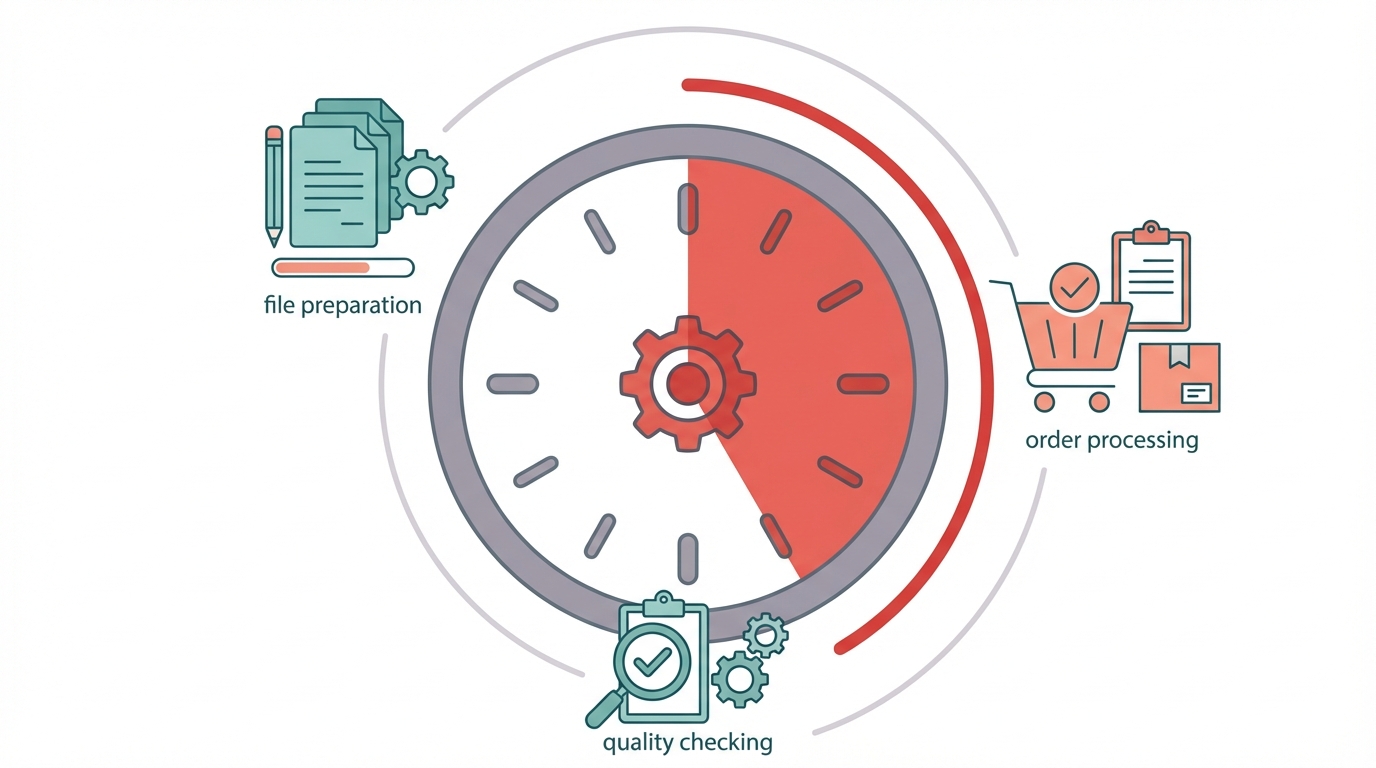
- File preparation: 10-15 minutes per order to check resolution, convert color profiles, add bleeds, and format for production
- Order processing: 5-10 minutes per order downloading files, organizing them, and routing to production
- Quality review: 5 minutes per order checking designs against printable areas
That is 30 minutes of manual work per order. At 10 orders per day, you are spending five hours on tasks that produce zero revenue. Double your orders and you have lost your entire day.
This is why the ceiling exists. Revenue growth requires more orders, but more orders require more of your time in operations. Without automation, any attempt to scale a custom apparel business means working longer hours, not building a bigger operation.
Five bottlenecks that stall custom apparel growth
The bottlenecks show up in a predictable sequence as order volume increases. Understanding which ones affect you helps prioritize what to fix first.
Here are the five bottlenecks, in the order they typically appear:
- Manual file preparation — converting customer designs to production-ready files
- Order processing overhead — downloading, renaming, sorting, and routing files
- Shopify’s variant limit — the 100-variant cap fragmenting product catalogs
- Quality control at volume — verifying each unique design individually
- Fulfillment coordination — managing file delivery and tracking across orders
Each one compounds as order volume grows. Here is how they work and how to solve them.
1. Manual file preparation
This is the bottleneck that bites first and hardest. Customer designs look great on screen, but screen-optimized images are not production files. Every order requires converting RGB to CMYK, verifying resolution at print size, adding bleed zones, and exporting in the format your equipment needs.
At five orders per day, this is tedious. At 20 orders per day, it is unsustainable. Merchants who do not automate file preparation typically cap out around 15-20 daily orders regardless of demand.
Tools with automated print-ready exports handle this conversion automatically–generating PDF, PNG, or SVG files with correct color profiles, bleeds, and resolution on every order.
2. Order processing overhead
Downloading customer files one at a time, renaming them, sorting them into folders, and sending them to your production queue–it sounds small. At volume, however, it compounds into hours of daily busywork.
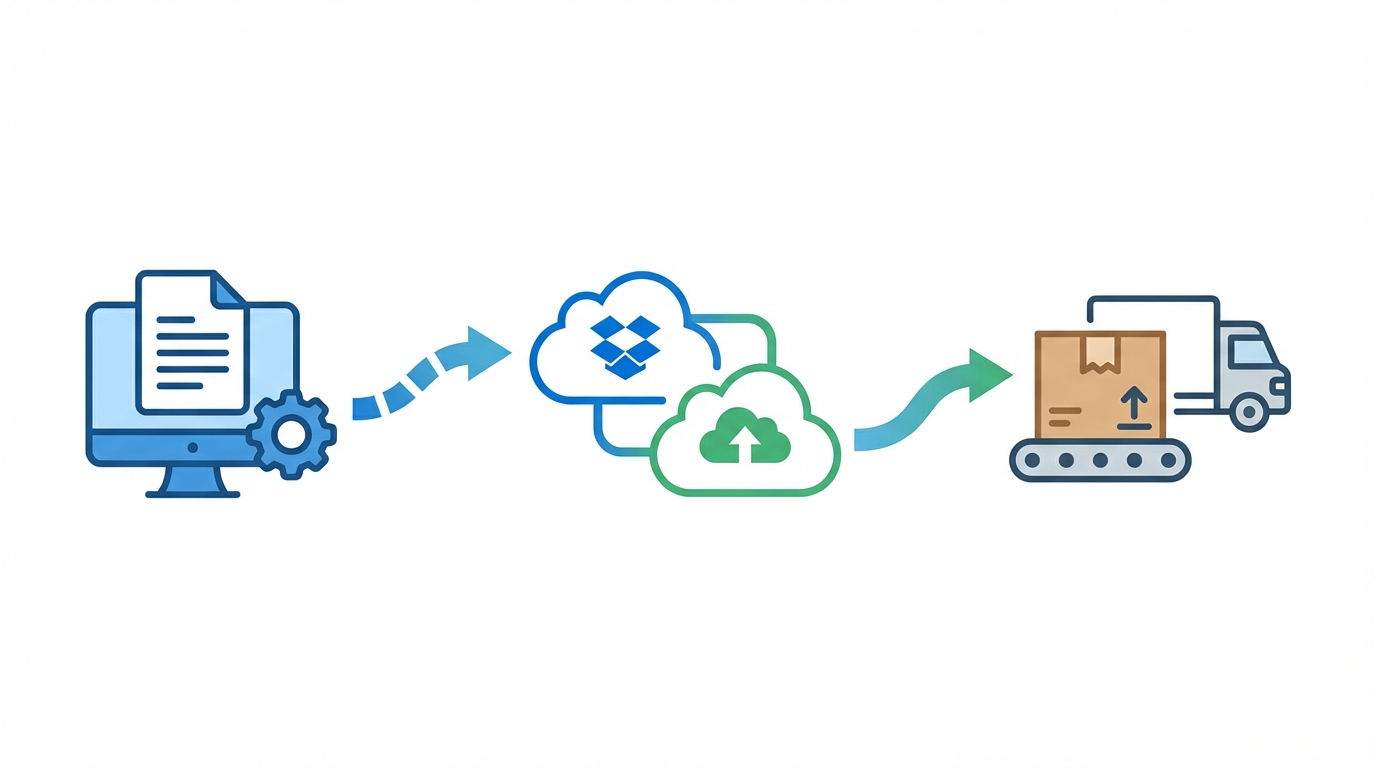
High-volume merchants eliminate this entirely by routing files automatically to cloud storage (Dropbox or AWS S3) or triggering production workflows through webhooks. As a result, the order flows from customer submission to production queue without anyone touching it.
3. Shopify’s variant limit
This bottleneck is Shopify-specific but affects most custom apparel Shopify merchants selling personalized products. Offer a t-shirt in five sizes, eight colors, and three print locations, and you have 120 variant combinations–already past Shopify’s 100-variant limit.
Most merchants work around this by creating duplicate product listings, which fragments inventory tracking and confuses customers. A custom apparel product customizer for Shopify handles variant complexity without the workarounds, keeping your catalog clean even as product options multiply.
4. Quality control at volume
When every product is unique, quality control cannot rely on inspecting a sample batch. Each order needs individual verification: Is the resolution high enough? Are design elements within the safe zone? Will this actually print correctly?
Proactive quality gates–including real-time 3D product previews–solve this at the point of order, not after production starts. Resolution warnings flag low-quality uploads before customers check out. Safe positioning constraints prevent designs from bleeding off printable areas. Problems get caught before they become production waste and customer complaints.
5. Fulfillment coordination
Whether you print in-house or use a print-on-demand partner like Printful, coordinating fulfillment becomes complex at scale. Files need to reach the right production queue in the right format at the right time. Additionally, tracking needs to stay accurate across dozens of daily orders.
Manual coordination–emailing files, checking statuses, updating tracking–is manageable at low volume. At scale, it becomes the bottleneck that drives hiring decisions. Automated integrations handle this coordination systematically, so you scale with software instead of staff.
Building the apparel automation workflow for scale
The merchants who break past $10K share a common approach: they automate systematically, starting with the highest-impact bottleneck and working down.
Phase 1: Automate file exports
Start here. This single change eliminates the biggest time drain in most custom apparel businesses and forms the foundation of a reliable apparel automation workflow.
Configure your visual product customizer to generate production-ready files automatically:
- File format: Set your default export to match your production equipment (PDF for most DTF and DTG workflows)
- Color profiles: Automatic CMYK conversion eliminates manual Photoshop work
- Bleed zones: Configure bleed and safety zones per product so every export is print-ready
- Resolution enforcement: Set minimum DPI requirements so customers cannot submit files that will print poorly
This phase typically eliminates 60-70% of the manual work in a custom apparel workflow. Orders go from “customer designs product” to “production-ready file exists” without human intervention.
Phase 2: Connect production systems
Once files generate automatically, the next step is automating how they reach your production team.
- Cloud delivery: Files route automatically to Dropbox or AWS S3 folders organized by order, product, or date
- Webhook automation: Order events trigger your production workflow–new order placed, file ready, order shipped
- Batch processing: Process multiple orders simultaneously during peak periods instead of handling them one at a time
This phase removes the “download, rename, organize, send” loop that eats hours during busy periods. Your production team pulls files from an organized system instead of waiting for someone to prep and deliver them.
Phase 3: Scale fulfillment with print on demand automation
For merchants using print-on-demand, print on demand automation is the final piece: connecting your customizer directly to fulfillment partners like Printful closes the gap between custom orders and shipped products. Customer designs flow from your store to production to shipping without manual hand-offs.
For in-house production, the automated file delivery from Phase 2 becomes your scaling infrastructure. Adding production capacity means adding equipment and operators, not file prep staff.
What $10K+ operations look like in practice
The difference between a $5K and a $25K custom apparel business is rarely about marketing or product quality. It is about whether operations can absorb the volume.
| Revenue Level | Orders/Day | Operations Reality | Key Constraint |
|---|---|---|---|
| $10K/month | ~10 | Painful but survivable; one person handles all | Time |
| $25K/month | ~24 | Full workday consumed by file prep; growth vs. operations tradeoff | Headcount |
| $50K/month | ~48 | Automation is structural; time goes to strategy | Systems |
The merchants who scale smoothly through these stages build automation before they need it. The ones who stall wait until operations are already breaking.
According to industry data from Printful, the print-on-demand market is growing at 26% annually. The demand trajectory favors custom apparel businesses that can handle volume. The question is whether your systems can keep up.
Common mistakes that keep custom apparel businesses small
Knowing what not to do matters as much as knowing what to automate.
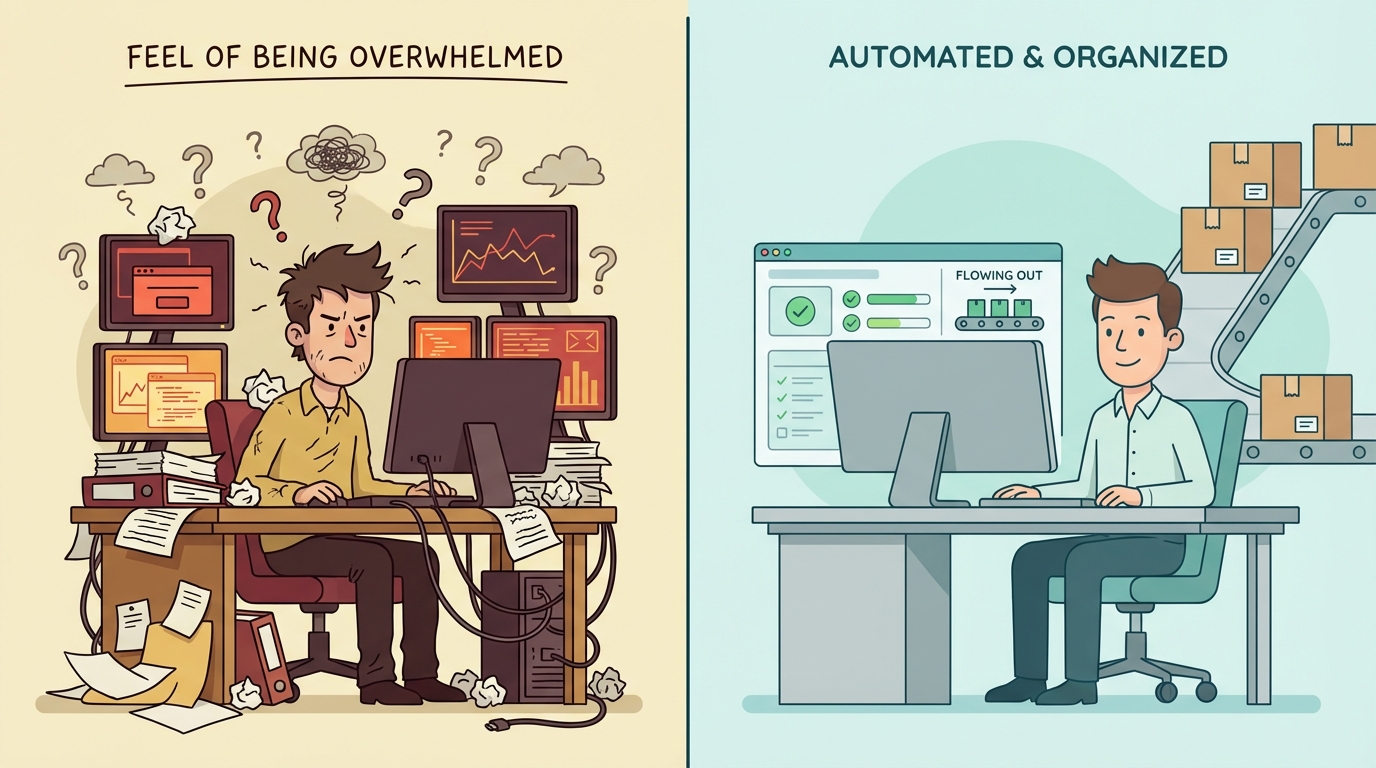
Hiring before automating. When trying to scale a custom apparel business, adding staff to handle manual file prep feels logical. But it creates linear cost growth. Each additional 10 orders per day requires another person. Automation handles volume increases at zero marginal cost.
Optimizing the wrong bottleneck. Many merchants invest in faster production equipment while their file preparation process is the actual constraint. Identify where orders get stuck before investing in speed.
Treating mobile as secondary. 70-80% of e-commerce traffic comes from mobile devices. If your product customization experience is clunky on phones, you are losing the majority of potential customers before they even place an order.
Avoiding the 100-variant problem. Creating duplicate Shopify product listings to work around variant limits creates inventory confusion and a poor customer experience. Solve the root cause with a customizer that handles variant complexity natively.
Frequently asked questions
How much does it cost to automate a custom apparel business?
The cost depends on your current stack and volume. A product customizer with built-in automation typically runs $30-$100 per month. Compare that to hiring a part-time employee at $1,500-$2,000 per month to handle file prep manually. For most merchants, automation pays for itself within the first month of use.
What is the best Shopify app for custom apparel?
Look for a dedicated Shopify app (not a generic widget) that offers print-ready file exports, variant management beyond the 100-variant limit, and automated file delivery to your production systems. Chamevo is built specifically for merchants who need production-grade automation alongside a storefront-integrated customization experience.
How do I automate my print on demand workflow?
Start with automated file exports from your product customizer. Then connect your file delivery to cloud storage or fulfillment partners through webhooks. The goal is eliminating every manual step between “customer places order” and “production starts.”
Getting past the ceiling
Scaling a custom apparel business past $10K per month comes down to a straightforward principle: automate the work that scales linearly with orders, and spend your time on the work that scales the business.
Key takeaways:
- The $10K/month ceiling is an operations problem, not a demand problem
- File preparation is the highest-impact bottleneck to automate first
- A three-phase apparel automation workflow (file exports, production systems, fulfillment) scales systematically
- Hiring before automating creates linear cost growth that limits margins
- The right product customizer eliminates manual work at every stage
The bottlenecks are predictable–file preparation, order processing, variant management, quality control, and fulfillment coordination. The solutions to scale custom apparel business operations are equally proven: automated print-ready exports, cloud file delivery, print on demand automation through webhooks, and integrated fulfillment.
Start with file exports. It is the highest-impact change you can make, and you will see results within the first week. Then build outward–connect production systems, add quality gates, and integrate fulfillment.
Ready to automate your custom apparel workflow? Try Chamevo free for 14 days on Shopify and see how automated print-ready exports, cloud delivery, and production-grade file handling change your daily operations. Check plans and pricing to find the right fit for your volume.